If you’re in the market for nylon staple fiber (NSF), you’ve probably stumbled on one question more than any other: what’s its tensile strength, exactly? As a supplier who works with this stuff daily, I get it—tensile strength isn’t just a number for us; it’s what makes NSF useful for everything from upholstery to carpet, apparel to industrial fabrics. Let’s break this down like we would on a shop floor, no stuffy jargon, no vague claims, just what you need to know. Nylon Staple Fiber

First off, let’s clear up a common myth: there’s no single “tensile strength” for nylon staple fiber. It’s not like a metal bolt that’s always rated at a specific PSI. Tensile strength here depends on so many factors—what type of nylon it is, how the fiber’s made, its denier (that’s the thickness, for the uninitiated), and even if it’s been treated for extra durability. Let’s start with the basics: nylon 6 and nylon 6,6 are the two main types we supply, right? Nylon 6 is cheaper to make and works great for everyday uses, while nylon 6,6 is tougher—think the kind used in heavy-duty work gear.
For reference, the “tensile strength” we talk about for NSF usually falls in two categories: tenacity (strength per unit of linear density, measured in grams per denier or g/den) and breaking strength (total force needed to snap a fiber, measured in Newtons or pounds). That’s not just confusing jargon—why it matters: if you’re making a soft T-shirt, you don’t need a 5 g/den fiber; if you’re making commercial carpet that gets walked on 10 hours a day, you do.
Let’s get to the real numbers we stand behind. For standard nylon 6 staple fiber, which is what most folks go to for apparel, home textiles, and light industrial uses, the tensile tenacity usually ranges from 3.5 to 5.5 g/den. That means a fiber that’s 1 den thick (about as thin as a spider’s silk, roughly) can handle 3.5 to 5.5 grams of force before it breaks. If you’re looking at nylon 6,6, it’s higher—usually 4.5 to 6.5 g/den. Why the difference? Nylon 6,6 has a more tightly packed molecular structure, so it resists stretching and breaking better. We also make high-tenacity (HT) NSF for heavy-duty jobs, like rope, tire cords, or industrial filter bags—those top out at 7 to 9 g/den. That stuff’s built to take a beating, no joke.
Now, why do these numbers vary so much? Let’s talk about how we make our fiber. The spinning process is everything. When we extrude the nylon polymer into fibers, how fast we cool it, how much we stretch it (that’s called drawing), and what additives we put in make a huge difference. If we stretch a fiber more, the molecules line up tighter, so it’s stronger. But stretch it too much, and it gets too brittle—you don’t want that, especially for fabrics that need to flex. We also add anti-static or UV-stabilizing additives for outdoor uses, and those can tweak tensile strength a little—usually not by a ton, but something to note if your application is specific. Denier matters too: thicker fibers (higher denier) will have a higher total breaking strength, but their tenacity per den might be a little lower. That’s because a thicker fiber has more material, so it can handle more force overall, but per gram of fiber, it’s not as strong as a thinner, more tightly drawn fiber.
I hear a lot of customers mix up tensile strength with elongation, too—super common. Elongation is how much a fiber stretches before it breaks, and nylon’s got way better elongation than polyester, for example. A standard NSF stretches 20 to 40% before snapping, while high-tenacity stuff can stretch 15 to 25%. That’s why nylon’s so great for fabrics that need to move—jeans, athletic wear, even upholstery that gets sat on a lot. You don’t want a fabric that snaps when you bend over, right?
Let’s put this in real-world terms so it hits home. If you’re making a casual t-shirt with 15 denier NSF, that fiber’s tenacity is around 4 g/den, so it can take about 60 grams of force before breaking. That’s more than enough for everyday wear—you’re not going to pull a t-shirt that hard. If you’re making a commercial carpet with 100 denier nylon 6,6 staple, that’s 5.5 g/den, so total breaking force is 550 grams. Imagine thousands of those fibers packed into a carpet—you can walk, run, even drag a chair across it, and it won’t snap. For a heavy-duty conveyor belt, we use 200 denier high-tenacity NSF at 8 g/den, so that’s 1600 grams per fiber—way more than the weight of any package you’d put on a conveyor.
Now, let’s talk about what affects tensile strength over time, because no one wants a fiber that gets weaker after a few washes or years. Nylon’s naturally durable, but UV light, harsh chemicals (like bleach), and high heat can break down its molecules, lowering tensile strength. That’s why if you’re making outdoor fabrics (like patio cushions), we supply NSF with UV stabilizers that cut that strength loss by 30% or more. If you’re using it for industrial cleaning cloths, we add chemical resistance additives so it doesn’t weaken when you use bleach or degreasers. We always tell customers: “Tell us where you’re using this fiber, and we’ll adjust the tensile strength to match.”
I’ve had customers come to me before thinking, “Higher tensile strength is always better.” But that’s not true! If you use a high-tenacity fiber for a delicate baby blanket, it’s going to be stiff, scratchy, and not stretch right. We once had a customer who ordered 6 g/den NSF for a children’s sleepwear line—they ended up returning 1000 kg because it was too harsh. We swapped them for 4.5 g/den nylon 6, and they loved it. That’s the thing about being a supplier—we don’t just give you a number; we help you pick the right number for your project.
Another thing: there’s a difference between lab-tested tensile strength and what you get in actual production. We test every batch of NSF we make—pull samples in our quality lab, run them through a tensile tester, and keep records. But sometimes, a small batch might have a 0.5 g/den difference, and that’s normal. We never send out a batch that’s below the minimum we promise, though—our customers rely on that consistency.
So, to wrap up the basics: the tensile strength of nylon staple fiber isn’t a fixed number, it’s a range. For everyday uses, 3.5 to 5.5 g/den for nylon 6, 4.5 to 6.5 g/den for nylon 6,6. For heavy-duty, go up to 7 to 9 g/den. The key is matching that number to your application—no overbuying strength you don’t need, no underbuying strength that’ll break.
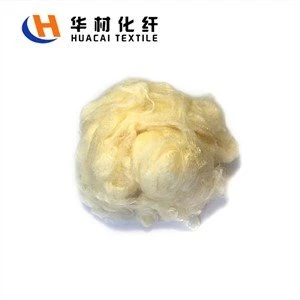
If you’re working on a project and need the exact tensile strength for your specific use, don’t guess. We’re the folks who make this fiber, we know every batch, we can walk you through what works best. Whether you’re a textile manufacturer, a carpet maker, or someone making industrial parts, hit us up to chat through your needs. No sales pitch, just straight talk about nylon staple fiber, how it works, and what’ll make your product stand out.
Polyester Tow References:
- Textile Institute. (2019). Handbook of Technical Textiles: Fiber Properties. Woodhead Publishing.
- ASTM D3822. (2021). Standard Test Method for Tensile Properties of Single Textile Fibers. ASTM International.
- Synthetic Fiber Manufacturers Association. (2020). Nylon Staple Fiber: Properties and Applications. SFMA Publication.
Huacai Group
Huacai Group is well-known as one of the leading nylon staple fiber manufacturers and suppliers in China, featured by quality products and good service. Please feel free to buy bulk nylon staple fiber at competitive price from our factory.
Address: No.188 Zhenyang Road, Qingyang Town, Jiangyin City, Jiangsu Province, China
E-mail: sales@huacaifiber.com
WebSite: https://www.huacaifiber.com/
