Hey folks, I’m Jake, and I’ve been running the stamping floor at our shop—we make stamped parts for both gas-powered cars and EVs—for 12 years now. Every single day, someone hits me up asking, “Why is that bracket or frame so much more expensive than the last one I got?” It’s not a random number, I promise. There’s a whole mess of factors that go into stamping part costs, and I’m gonna break ’em down like I would for a new hire on the floor—no fancy jargon, just real talk from someone who’s been there when a last-minute material swap turned a $5 part into a $15 headache. Automotive & EV Stamping Parts
First off, let’s talk materials, because that’s the biggest line item on our bills—hands down. People always sleep on this, but it’s not just “steel is steel.” For gas car parts, you’ve got mild steel, which is cheap, easy to stamp, but not great for lightweighting. Then there’s advanced high-strength steel (AHSS)—that stuff can be 2 to 3 times more expensive than mild steel, and it’s way trickier to work with. It’s harder, so it wears out our stamping dies faster, and it needs more pressure in the press, which means we burn through electricity quicker. Now, EV parts? They’re all about lightweighting to boost range, so we’re dealing with aluminum alloys, high-strength aluminum, even things like magnesium for some inner structural parts. Aluminum is not only more expensive upfront than mild steel, but it’s way more malleable in a way that’s annoying—you have to adjust the press speed constantly to avoid cracking, and it dulls die surfaces way faster. I remember a job last year for a startup EV that used 6061-T6 aluminum for a battery tray bracket—we ended up having to re-grind three dies in the first two weeks of runs because the aluminum was tearing at the edges, and that ate into our profit margin hard. Also, material grades matter even for the same metal. A 1008 steel vs. 1010 is a few cents more per pound, but if the customer’s part needs that extra strength to support a battery pack, you can’t cut corners. And let’s not forget about scrap rate—if a material is prone to springback (that weird thing where the part bends back after you stamp it), you’re throwing out a lot more of it. Last quarter, we had a job for a gas tank shield that used a springy AHSS, and our scrap rate jumped from 5% to 18%—that’s 13% more material we had to buy for free, basically.
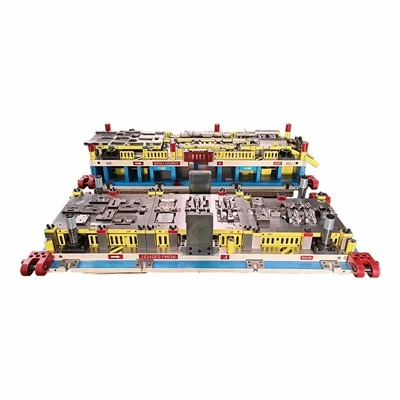
Next up, die design and tooling—this is where the “hidden cost” stuff lives, the stuff customers rarely see until they get the bill. Stamping dies are custom tools, right? You can’t use the same die for a door bracket for a Ford F-150 and a door bracket for a Tesla. The complexity of the part directly ties to how much the die costs. If you’ve got a simple flat bracket that just needs a bend or two, the die might be $2,000. But if you’ve got a battery tray that has 12 bends, two cutouts for wires, a flange that has to be precision-measured to within 0.1mm to seal to a plastic casing, and it has to be done in one hit to keep costs low? That die’s $15,000, easy. And for EV parts, die complexity is through the roof because battery packs need super precise, consistent parts to avoid leaks or electrical issues. Then there’s the material we make the dies out of. If it’s a low-volume job (like for a new EV startup testing their prototype), we might use a die made from a less durable steel—cheaper upfront, but it’ll only last 10,000 parts before it’s too worn to use. For high-volume parts, like a bracket for a mass-market EV that sells 500,000 units a year, we use a tool steel that’s way more expensive, but it lasts 1 million+ parts so the per-part cost drops. I’ve had customers say, “Why not just use the cheaper die even for high volume?” But then they come back after 30,000 parts, complaining that all their brackets are coming out too big and they can’t seal the battery pack. Bad dies lead to bad parts, and that’s way more expensive than paying a few grand extra for a better die.
Press capacity and run conditions—this is the stuff that happens on the floor every day, not on a quote. Stamping presses come in all sizes: from tiny 50-ton presses for small clips to 2,000-ton behemoths for big structural parts like chassis rails. If your part needs a 1,500-ton press, and that press is only used for 10 jobs a month (because not many parts need that much force), the cost to reserve that press gets spread over fewer parts, so the per-part cost goes up. Last year, we had a job for a battery housing side member that needed 1,800 tons—our only press that big is usually running 8 hours a day for high-volume work, so we had to schedule that job for weekends, which means our team gets overtime, and the press uses more power when it’s running slower on low-volume jobs. That adds 20% to the cost of that part, easy. Also, run speed. For simple parts, we can run 15 parts per minute—fast, efficient, cheap. For complex parts with tight tolerances, we have to slow down to 8 or 10 parts per minute, because if we run too fast, we get misfeeds or parts that are out of spec. That means less parts per hour, so more labor cost per part. Labor is another big one, by the way. Stamping isn’t robot-only, even though a lot of people think that. You need a setup guy to calibrate the die every time we switch jobs, a press operator to monitor the run, a quality person to check parts every 1,000 parts. If a job needs more setups a month (like a prototype job that runs 1,000 parts here, 500 parts there), that adds labor time. High-volume jobs that run 24/7 with minimal changeovers have lower labor per part, obviously.
Quality and tolerance requirements—EV parts are way stricter here than old gas car parts, and that’s a huge cost driver. A gas car door bracket might have a tolerance of ±0.5mm—easy to hit, no big deal. A battery tray bracket that has to align with a bus bar? Tolerance is ±0.1mm. That means every part has to be checked with a coordinate measuring machine (CMM), which is slow and uses a technician’s time, not just a quick visual check. Also, if you need zero defects for safety-critical parts (like parts that hold the battery pack, or parts that affect braking), you have to add 100% inspection instead of sampling. We had a job last year for an EV battery mounting bracket—customer required 100% inspection with a CMM, and that added 15% to the part cost because we had to have a tech dedicated just to checking parts all day. Plus, if you have to meet ISO or IATF 16949 quality standards (which almost all automotive customers require now), that means more documentation, more audits, more time spent tracking every part lot—another hidden cost that gets passed on.
Volume and production scale—this is the simplest one, but people underestimate it. Economy of scale is real, but only if the volume is consistent. If you need 1,000 parts, we can run them all in a week, maybe even use a temporary die that’s cheaper to make. If you need 100,000 parts, we have to schedule production around other jobs, make sure the die is maintained, order enough materials ahead of time to get a bulk discount, and that brings the per-part cost down a lot. But here’s the catch: EV startups often don’t know their volume when they’re starting out—they might order 500 prototype parts, then 10,000 for a small test run, then 100,000 for full production. Every time the volume jumps, we have to adjust the die, the run schedule, even the material supplier, and that can lead to cost spikes. I had a customer last year who went from 2,000 parts to 20,000 parts mid-job—they thought the cost would just drop, but because we had to re-calibrate the press for higher volume, switch to a more durable die, and bulk-order materials, the cost actually went up a little for the second batch. It’s not a linear thing.
Shipping and logistics, wait—don’t forget that. Stamped parts are often big, heavy, especially EV structural parts. A battery tray is 10 pounds, a chassis rail is 20 pounds, and if you’re ordering 10,000 of them, that’s a lot of weight. Also, EV parts need to be packaged safely—no dents, no scratches, because a dent in a bracket can make it not fit the battery pack. So we use custom foam inserts, sturdy crates, sometimes even moisture barriers if they’re made of aluminum to prevent corrosion. That packaging adds a few cents per part, but if it gets damaged in shipping, we have to re-make the parts, which is way more expensive. Also, if you’re ordering from overseas, lead times are longer, and you have to account for customs fees, tariffs, and shipping delays, which can add 10-15% to the total cost. We had a customer who tried to source a small aluminum bracket from China a few years ago—they saved 10% on the part, but the shipping took 6 weeks, and 5% of the parts were damaged, so they ended up paying more than if they’d sourced them locally.
Oh, and one last thing: regulatory and compliance stuff. For automotive parts, especially EVs, you have to meet things like REACH standards for materials, end-of-life recycling requirements, and fire safety standards for parts near the battery. That means we have to use materials that are on the approved list, keep documentation of every material batch, and test parts for fire resistance. For example, if a part is going near a lithium-ion battery, it has to be able to withstand high temperatures, so we can’t use certain plastics or lower-grade metals—we have to use specific alloys that meet those standards, which are more expensive. We had a job a while back for a heat shield near an EV battery—we had to switch from a standard steel to a high-temperature steel that cost 30% more, just because it had to withstand 500-degree heat for 10 minutes without melting.

Look, I get it—every customer wants the lowest possible cost, and that’s what we’re here for. But when you’re dealing with stamped parts for cars, especially EVs, there’s a lot more going on than just the price tag. It’s not that we’re marking up for no reason—we’re dealing with custom tools, strict quality checks, expensive materials, and all the little headaches that come with making parts that keep cars and EVs safe and running. If you’re working on an automotive or EV project, whether you’re a startup testing a prototype or a big manufacturer ramping up production, we can walk through your part, break down the costs, and find ways to keep it fair without cutting corners on quality or reliability. Hit us up to chat about your next stamping part project—we’re here to make the process as clear and stress-free as possible.
Custom Stamping Die References
- Automotive Stamping and Forming: Materials, Processes, and Cost Drivers, Society of Manufacturing Engineers, 2021.
- Lightweighting Strategies for Electric Vehicle Components, International Journal of Automotive Technology, Vol. 22, No. 3, 2021, pp. 789-802.
- IATF 16949:2016 Automotive Quality Management System Requirements, International Automotive Task Force, 2016.
- Cost Modeling for Sheet Metal Stamping Operations, Journal of Manufacturing Systems, Vol. 35, 2015, pp. 112-120.
Dongguan Changdong Tool & Die Co., Ltd.
With abundant experience, we are one of the most reliable automotive & ev stamping parts manufacturers and suppliers in China. Please feel free to buy advanced automotive & ev stamping parts made in China here from our factory. Good service and quality products are available.
Address: No. 56-B, Fumin South Road, Dalang Town, Dongguan City, Guangdong Province, China
E-mail: sales@stamping-die.com
WebSite: https://www.metalstampingdie.com/
