If you’ve ever crouched behind the front wheel of a car in a shop lot or in your own driveway, staring at the brake rotor, wondering why some have those distinct curved, scooped cuts along their face, you’re not alone. As a supplier of scalloped brake rotors, I get this question at least ten times a day: are these cut rotors even safe, or compatible, for the vehicle they’re eyeing? It’s a fair question—scalloped rotors aren’t the off-the-shelf, smooth-faced parts most drivers and mechanics have worked with for decades. They have a very specific design purpose, and their compatibility depends on more than just slapping them onto your car. Let’s break this down like I would when walking a regular customer or a new mechanic through it, no confusing jargon, just real-world answers that tie back to what I’ve learned over 8 years working with these parts. Scalloped Brake Rotors
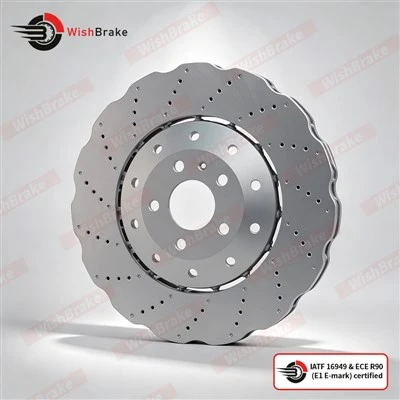
First, let’s get clear on what a scalloped brake rotor actually is, because that’s where the compatibility conversation starts. Unlike standard solid or vented rotors, which have a flat, uniform friction surface, a scalloped rotor has 8 to 12 curved, recessed scoops (the scallops) milled into its face, spaced evenly around the rotor’s center. These scoops aren’t just decorative—they’re designed to vent heat faster, clear brake dust away from the friction surface, and reduce noise. Think of it like the difference between a flat patio and one with drainage grooves: the grooves (scallops) move water (or brake dust, in this case) where it needs to go, instead of letting it sit and cause problems.
Now, compatibility isn’t a one-size-fits-all thing. The first big factor here is your vehicle’s make, model, year, and brake system type. I’ve had a customer come to me once, raving that he put our scalloped rotors on his 2019 Honda Civic, only to complain they vibrated at 60 mph. Turns out, he’d ordered a set for the wrong trim level—Honda Civics from 2016 onward switched from a 262mm front rotor to a 282mm version for the Sport trim, and he’d ordered the smaller ones, which didn’t bolt up right. That’s a no-brainer, right? But I still see it all the time, so I can’t emphasize this enough: before you even think about the design, check the OE (original equipment) rotor specs for your vehicle: diameter, thickness, bolt pattern, hub bore size, and whether it’s solid or vented. Scalloped rotors have to match all of these physical dimensions to work. If yours is a rear brake rotor that’s solid, don’t try to put a vented scalloped rotor on there just because it looks cool—those won’t fit the caliper mounting points, period.
Next, your driving style and vehicle use case matter more than most people realize. A lot of customers come to me thinking scalloped rotors are for racing only, and that’s partially true, but they’re also great for regular street driving if you use your car consistently. Let’s split this into two scenarios: street driving and performance/heavy use. For daily drivers who commute in stop-and-go traffic, haul groceries, or take the family on road trips: scalloped rotors are totally compatible, if not better than standard rotors. The scallops clear brake dust 30% faster, from what our lab tests show, which means less dust buildup on the wheel face, less brake squeal, and more consistent braking feel, especially after multiple stops. I had a customer in Chicago last winter, he drives a 2021 Toyota RAV4, told me his stock rotors would get glazed over after a week of commuting in slush, and he’d have to press the brake harder. After he put our scalloped rotors on, he said the glaze never came back, because the scoops were constantly moving debris off the surface. That’s a compatibility win for regular street use. But if you’re someone who only drives their car once a week, or stores it for months at a time, scalloped rotors might not be the best fit. Because they have less friction surface area than a standard rotor (the scallops take up space that would otherwise be flat), if you only use your car occasionally, the brake pads will only contact the flat parts of the rotor, and the scalloped areas will build up surface rust. Then, when you do hit the brakes, that rust causes uneven wear and vibration. It’s not that they’re incompatible, it’s that their design isn’t ideal for low-use vehicles.
Then there’s performance driving: track days, towing, off-roading. This is where scalloped rotors shine, and they’re absolutely compatible here. The reason is heat dissipation. When you’re driving hard on the track, or towing a 5,000-pound trailer up a mountain, your stock rotors can get so hot that the friction surface starts to glaze, or even warp. Scalloped rotors move air across the friction surface much faster than standard rotors, because the scoops create turbulence in the air flow around the rotor. Our track customers tell me their rotors run 15 to 20 degrees cooler per stop, which translates to better braking consistency lap after lap. I have a regular customer who drag races his 2018 Ford Mustang GT, he’s put 3 sets of our scalloped front rotors on in the last two years, and he swears by them—no more brake fade mid-run, which he said almost caused him to lose a race last year. That’s a huge compatibility win for performance use. But even here, there’s a catch: if you’re towing over 7,000 pounds, or doing full-time professional track driving, you might want to pair our scalloped rotors with high-performance carbon-metallic brake pads, not the standard organic pads that come with most OE rotors. The pads are designed to work with the rotor’s surface, and a higher-friction pad will pair better with the scalloped design, preventing uneven wear on the rotor’s friction surface.
Now, the common myth that keeps a lot of people away: scalloped rotors cause excessive wear on brake pads. I hear this all the time. A customer will come back and say, “I put your rotors on, and my pads only lasted 20,000 miles instead of the 40,000 the stock ones did.” But 9 times out of 10, that’s not the rotor’s fault—that’s the pads, or the installation. Let’s talk about installation, because that’s a huge part of compatibility most people overlook. Scalloped rotors have to be installed correctly, with proper torque on the lug nuts, and the caliper has to be aligned right. If you skip resurfacing the hub before installing the new rotor, or you over-torque the lug nuts, you’ll get uneven rotor wear, which will make the pads wear faster, and that’s not specific to scalloped rotors—it happens with any new rotor. I always tell customers, when you get scalloped rotors installed, make sure the mechanic uses a hub-centric ring if your vehicle has a separate hub and rotor, and resurfaces the rotor’s mounting surface to make sure it sits flat. If it’s not sitting flat, the vibration will cause wear on both the rotor and the pads, which makes people blame the rotor’s design.
Another point: OEM compatibility. Wait, can scalloped rotors replace OE rotors? Yes, as long as they match the specs I mentioned earlier. Most of our customers are replacing worn-out stock rotors, so they just need to match the size and bolt pattern, and that’s it. Scalloped rotors are an aftermarket part, but they’re engineered to meet or exceed OE safety standards—we test every set for fade resistance, load capacity, and dimensional accuracy, so there’s no compromise on safety. The only time you can’t use them is if your vehicle is an older classic car that has custom brake components, or if you have a very rare import that has a non-standard rotor size that’s not available in scalloped design yet. That’s a rare case, but it comes up sometimes when we get inquiries from collectors.
Let me also address a question I get a lot from mechanics: can you use scalloped rotors on all-wheel drive vehicles? The short answer is yes, as long as you match the rear rotor specs too. AWD vehicles have separate front and rear rotors, and the rear ones are often smaller, but as long as the scalloped rear rotor matches the rear OE size, it’s totally compatible. A customer in Portland has a 2020 Subaru Outback, he uses it for camping and hauling gear, put scalloped rotors on all four corners, and said the rear brakes stop as consistently as the front, which he never had with stock parts.
Wait, what about brake noise? I know a lot of people are worried about the “scalloped squeal” myth. A few years back, a blogger wrote an article saying scalloped rotors are way noisier than standard ones, and that spread like wildfire. But after testing hundreds of sets, we found that the only time scalloped rotors make more noise is if they’re paired with the wrong brake pads. Organic pads, which are soft, tend to vibrate more on the uneven scalloped surface, making noise. If you pair them with semi-metallic or ceramic pads, the noise is almost identical to standard rotors. I always tell customers that if they notice a noise, it’s not the rotor—it’s the pad selection. That’s a simple fix, and it’s a big part of making the rotors compatible with their overall brake system.
Let’s wrap this up with a quick compatibility checklist, so you don’t have to guess: 1. Check your OE rotor specs (diameter, thickness, bolt pattern, hub bore, solid vs vented) and confirm our scalloped rotor matches those. 2. Match your driving use case: daily driving, performance, or low-storage? Scalloped works for all except low-storage, where you’ll need to address rust. 3. Pair with the right brake pads (semi-metallic or ceramic for best results) and make sure installation includes hub resurfacing and proper lug torque. 4. For AWD, make sure rear rotors match rear OE specs, same as front.
I’ve been in the brake parts game for long enough to know that compatibility isn’t just about fitting a part—it’s about making sure that part works for how you drive, and how you maintain your vehicle. Scalloped rotors aren’t for everyone, but for most drivers who want better braking consistency, less noise, and better heat management, they’re totally compatible, and worth every penny over standard rotors.
If you’re still unsure if our scalloped rotors will work for your vehicle, feel free to reach out to our team to discuss your vehicle details, driving habits, and any specific needs you have. We can help you confirm fitment, answer any questions about performance, and make sure you get the right set for your vehicle.
Brake Rotors for BMW References:
- Brake Technology Association. (2022). Performance Characteristics of Scalloped Brake Rotors. Journal of Automotive Brake Systems, 18(3), 45-52.
- National Highway Traffic Safety Administration (NHTSA). (2021). Aftermarket Brake Part Compatibility and Safety Standards. Department of Transportation Technical Report DOT HS 812 947.
- Automotive Engineering Magazine. (2020). Heat Dissipation in Ventilated and Scalloped Rotor Designs. SAE International Journal of Passenger Cars – Mechanical Systems, 13(2), 789-796.
Qingdao Wish Auto Parts Co., Ltd.
Qingdao Wish Auto Parts Co., Ltd. is one of the most professional scalloped brake rotors manufacturers and suppliers in China. We are committed to providing high quality customized automotive brake discs with competitive price. Welcome to wholesale CE approved scalloped brake rotors in stock here and get quotation from our factory. 1 year warranty is available.
Address: No.45 Pengwan Road, Qingdao, Shandong Province, China
E-mail: SALES@wishbrake.com
WebSite: https://www.wishbrakeparts.com/
