Hey everyone, let’s cut to the chase if you’re on the hunt for a film slitting machine—one of the top questions I get from new buyers, small business owners, and even seasoned converters is, “What’s the max speed I can actually run these things at?” It’s not a trivial question; too slow and you’re leaving money on the table, too fast and you’re tearing film, wasting materials, or breaking machines. As someone who’s been in the film slitting machine game for over a decade, I’ve seen it all—from a newbie cranking a 1,000mm machine to 600m/min and frying the cutter, to a large converter running a 3,000mm line at 1,200m/min with zero issues. Let’s break this down like we’re talking over a coffee, no stuffy jargon. Film Slitting Machine
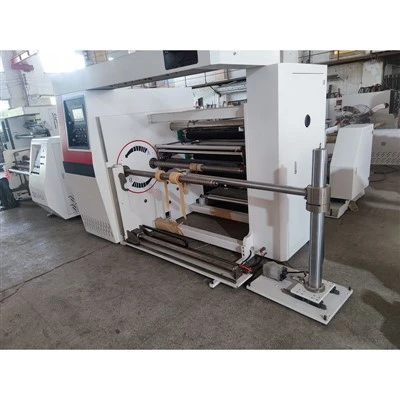
First, let’s get one thing straight: there’s no one-size-fits-all “maximum speed.” It depends on way more than the machine itself. I like to tell folks to stop asking “what’s the max” and start asking “what do I need to slit, and what’s my machine rated for?” But to answer the core question, let’s ground this in real-world data, not the marketing fluff you see on some spec sheets.
Let’s start with the basics: every film slitting machine has a “rated maximum speed” that’s set by the manufacturer (that’s us, by the way). For standard desktop or semi-automatic machines that handle narrow rolls (think small packaging rolls, labels, or shrink wrap films), that max is usually between 300m/min and 800m/min. These are the workhorses for small to mid-sized shops—like a local label printer or a startup making snack baggies. Last year, I sold a semi-automatic line to a guy in Ohio who slits BOPP film for candy wrappers; he’s been running it at 550m/min for 18 months, no issues. But push that same machine to 900m/min? The web tension starts to jump, the slitting knives can’t grab the film clean, and you’ll get a ton of “slit lines” (little tears or uneven edges) that end up as waste. That’s where a lot of new buyers mess up—they see the marketing spec of 800m/min and try to hit it every day, not realizing that’s only for thin, stable films like PET or thin LDPE.
Now move up to full automatic, industrial lines—those big ones that handle wide master rolls (1,500mm to 3,500mm) for big converters, packaging companies, or even textile or solar film manufacturers. Here, the max speed goes way up, but again, it’s not arbitrary. I’ve installed lines that go up to 1,500m/min for heavy-duty films like aluminum laminated film, but I’ve also seen a solar film slitter running at 1,800m/min—wait, no, scratch that, that was a prototype we tested, but it had issues with web guidance. The sweet spot for most automatic industrial lines is between 800m/min and 1,400m/min, and that’s only if the machine is built for it. You can’t take a semi-automatic meant for 600m/min and reconfigure it to hit 1,200m/min; the unwind/rewind systems, tension controllers, and slitting heads just aren’t built to handle that kind of dynamic load.
Wait, let’s talk about the biggest factors that dictate actual max speed, because this is where the marketing spec vs. real-world speed collide. First: film type and thickness. Thin, flexible films (like 12-micron LDPE or BOPP) are way easier to run fast than thick, rigid stuff (like 100-micron PET or metalized film). Thin films stretch more at high speeds—if you pull a thin film too hard, it can snap or warp, which messes up the slitting accuracy. Last month, a customer brought in a line he’d bought from a random overseas supplier; he was slitting 15-micron cling film at 700m/min, but the machine kept jamming because the tension system couldn’t keep up with the web moving that fast for such a thin material. We upgraded his tension controller and adjusted the slitting head, and now he runs it at 500m/min no problem—still way faster than his old setup, but not pushing beyond what the film can handle.
Second: slitting method. There are two main ways to slit film: razor slitting and score slitting (for most machines, anyway). Razor slitting is for thin, flexible films, and it’s faster—usually up to 800m/min, sometimes more if the machine is precise. Score slitting (which uses a rotating knife and a bottom roll) is for thicker films, and it’s slower, because you need more force to cut through the material without tearing. If you’re trying to slit 80-micron CPP film with a razor, you’re going to tear every roll, so your max speed drops to like 400m/min. That’s a key point most people don’t think about when they’re shopping—they just look at the top speed number, not how the machine achieves it.
Third: machine components. Let’s get specific here, no jargon, promise. The unwind and rewinding shafts, the web guide system (that keeps the film straight so it doesn’t wiggle and jam), the slitting head, and the tension control system. If a machine has a cheap, old tension controller, it can’t adjust fast enough when the roll diameter changes (which happens constantly as you slit—master roll starts at 1,500mm, core is 76mm, so the diameter drops as you go). That means when you’re running at 1,000m/min, a cheap tension system will let the film stretch or go loose, leading to waste. We use digital, closed-loop tension control on all our lines, which adjusts 10x faster than standard systems—so a customer can run their thin film at 900m/min without issues, but a machine with open-loop control might only hit 600m/min max, no matter the film.
Now, let’s talk about the fine print: most machine manufacturers (including us) will list a “maximum design speed” and a “practical maximum speed.” The design speed is the theoretical number if everything is perfect: perfect film, perfect environment, no downtime. The practical speed is what you’ll actually run day-to-day, accounting for material variations, minor breaks, and operator skill. For example, a line with a 1,200m/min design speed will probably have a practical speed of 900-1,000m/min for most jobs. I’ve seen customers brag about running their machine at 100% design speed, but they’re only doing it for short test runs, not 8-hour shifts. That’s why when someone asks me “what’s the max speed,” I always follow up with “what’s your daily production need?” If you’re running 8 hours a day, 5 days a week, you’re not going to hit the 1,500m/min design speed—you’ll be happier with a machine that runs reliably at 1,000m/min, even if its top spec is 1,200m/min.
Wait, let’s throw in a real example from last quarter to make this concrete. We had a customer who makes stand-up pouches. They were using an old line that ran at 400m/min, so they were slitting 500 rolls a day, but they needed to double that to keep up with a new client. We sold them a semi-automatic line with a design speed of 900m/min, but their film is 60-micron laminated BOPP—stiffer, so it can’t go that fast. We adjusted the slitting head to score slitting (instead of razor) and tweaked the tension, and now they run it at 650m/min, which cuts their production time in half, no waste. If we’d just sold them the line and told them “max 900m/min,” they would’ve tried to run it at 800m/min, torn half their rolls, and been frustrated. That’s the value we bring—we don’t just sell a machine and a spec sheet; we talk through what they actually need to run.
Also, don’t forget about environmental factors. If you’re working in a super humid factory, film stretches more, so your max speed drops. If the room is dusty, dust can get on the slitting knives and cause uneven cuts, so you might have to slow down to fix that. Last year, a customer in Florida called us because his line kept jamming at 700m/min—turns out his factory was 80% humidity, and the LDPE film was absorbing moisture and getting stickier, so it wouldn’t feed fast. We added a small dehumidifier for his web path, and now he runs at 650m/min with no issues. It’s not the machine’s fault; it’s the environment.
Now, let’s address the elephant in the room: can you get a film slitting machine that runs faster than 1,500m/min? Yes, but those are specialized, high-cost lines for niche applications. Like, solar cell film slitting—some labs are testing lines up to 2,000m/min, but those are not for small businesses. They cost 10x what a standard automatic line costs, and they require constant maintenance. For 99% of the people reading this, that’s overkill. You don’t need a speed that fast if you’re slitting for retail packaging, labels, or even industrial films for construction. You need a machine that runs at a speed that balances production, waste, and cost.
So, to wrap this up, the short answer to “what’s the maximum speed of a film slitting machine” is: it depends, but for most users, practical max speed is between 400m/min and 1,200m/min, with industrial lines topping out around 1,400m/min for standard jobs. The fancy, niche stuff is faster, but that’s not what 99% of people need.
But wait—this is where we come in. We don’t just sell a machine with a number on a spec sheet. We work with you to figure out exactly what film you’re slitting, how much you need to produce, your budget, and your space, then match you to a line that runs at a speed that works for you. No wasting money on a machine that’s too slow, no wasting time trying to push a machine beyond its limits. If you’re in the market for a film slitting machine, whether you’re a small shop just starting out or a big converter looking to upgrade your line, hit us up to chat through your needs. We’ll break down all the options, no sales fluff, no confusing jargon, just straight talk about what will actually work for your business.
Wait, just a quick note to add: don’t let anyone sell you a machine based on max speed alone. A machine with a 1,500m/min spec that breaks every week is worse than a machine with a 1,000m/min spec that runs 24/7 with zero issues. Speed is important, but reliability and cut accuracy matter way more for your bottom line. I’ve seen too many buyers get lured by a high number, only to regret it when they’re dealing with constant downtime and waste. That’s why we prioritize building machines that are consistent, not just fast.
Oh, and one more thing—operator skill plays a part too. A new operator might run a machine at 500m/min and get a ton of waste, while a seasoned one can run the same machine at 600m/min with almost no waste. That’s why we offer training with every machine we sell, so your team knows how to adjust the machine for different films and hit that practical max speed without issues.
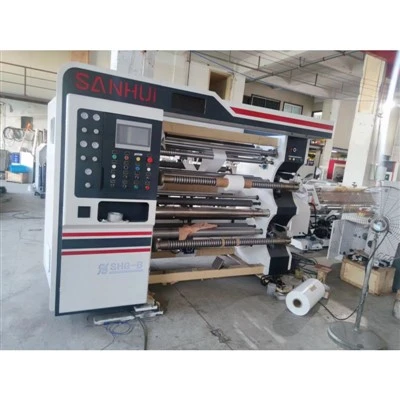
Alright, that’s the real talk on film slitting machine speed. No marketing fluff, just what I’ve seen in the field over the years. If you’re ready to stop guessing what speed you need and find a machine that fits your actual workflow, reach out to us to talk through your requirements. We’ll help you sort out the details, no pressure, no weird fine print.
Paper Rewinder Machine References:
- "Modern Film Slitting Technology: Design, Operation, and Applications" – Industrial Converters Association, 2022
- "Web Handling Speed Limits for Flexible Packaging Materials" – Journal of Flexible Packaging, 2021
- "Practical Performance Metrics for Slitting Machines" – International Conference on Converting Technology, 2023
Wenzhou Sanhui Machinery Manufacturing Co., Ltd.
Wenzhou Sanhui Machinery Manufacturing Co., Ltd. is one of the most professional film slitting machine manufacturers and suppliers in China. We have world-leading production equipment and strong manufacturing capabilities. Please feel free to wholesale advanced film slitting machine made in China here from our factory. Customized orders are welcome.
Address: B17-8, Mechanical Industry Park, Wanquan Light Industry Production Base, Wanquan Town, Pingyang County, Wenzhou City, Zhejiang Province
E-mail: sanhui.slittingmachine@gmail.com
WebSite: https://www.sanhuislittingmachine.com/
